Chromophore IOLs: What Does the Evidence Say?
Exploring the balance of tradeoffs.
EVALUATING CHROMOPHORE IOLS
Visual quality and function. Within the visible light spectrum, high-energy short-wavelength light causes greater scatter (contributing to dysphotopsias), induces more chromatic aberration,2 and causes more visual discomfort. Chromophore IOLs can improve night vision symptoms by reducing light scatter.3 However, because blue light plays an important role in scotopic vision,4 chromophores that filter blue light can have a negative effect on vision in low light. Color perception can also be affected.
Circadian rhythm. The circadian rhythm is important for cognition, sleep, metabolism, and many other aspects of physiological health. It is entrained by nonvision-related cells in the retina, known as intrinsically photosensitive retinal ganglion cells. When these cells are stimulated by blue light, particularly in the range of 460 to 480 nm, they release melanopsin, which suppresses melatonin, the hormone driving circadian rhythm function.4,6 Studies have shown that the implantation of a clear IOL improves sleep quality and cognition, but reports have been inconsistent regarding the impact of blue-light–filtering chromophore IOLs on the circadian rhythm.
TRADEOFFS
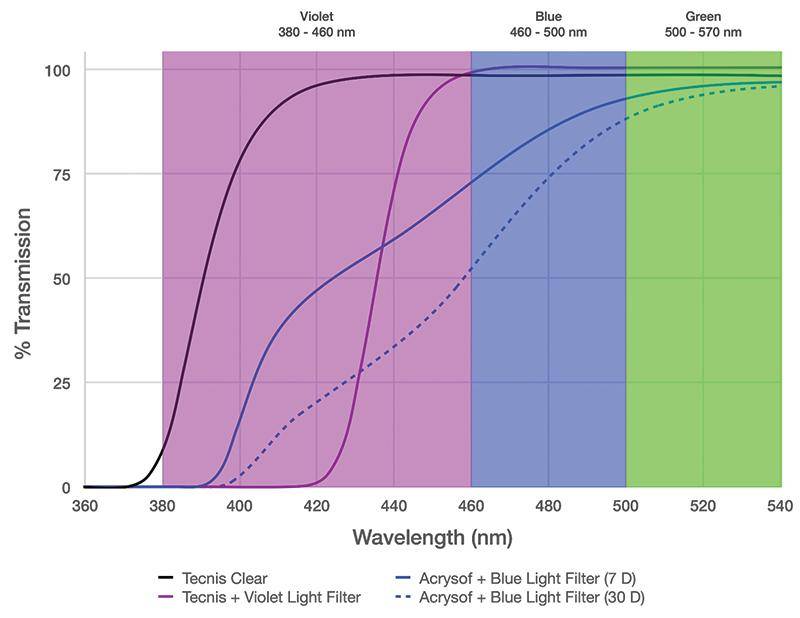
As with many aspects of IOL design, the ideal transmission profile of chromophores involves a balance of tradeoffs in visual quality and function, phototoxicity, and circadian rhythm. No chromophore is ideal under all circumstances. I would argue that the best approach is to block wavelengths that are known to be detrimental and to transmit wavelengths that may be beneficial. Because of an overlap in the benefits and drawbacks of high-energy wavelengths, it is helpful for a chromophore to have a steep cutoff in the transmission spectrum (Figure).

Ready to Claim Your Credits?
You have attempts to pass this post-test. Take your time and review carefully before submitting.
Good luck!