
Examining Dropless Versus Standard-of-Care Regimens Following Cataract Surgery
Dropless cataract surgery, or the use of intracameral nonsteroidal anti-inflammatory drugs and intracameral antibiotics at the time of the operation, has long been touted as a more patient-friendly option compared to having patients self-administer drops during the postoperative healing period. Previously, however, surgeons had no way of delivering a depot nonsteroidal medication at the time of surgery, meaning that patients undergoing dropless surgery would still have to use at least one drop postoperatively.
Results from a recent study, in which subconjunctival delivery of triamcinolone acetonide was added to intracameral phenylephrine 1.0%/ketorolac 0.3% and intracameral moxifloxacin, offers evidence that truly dropless surgery is not only feasible, but is preferred by patients.1 According to Dr. McCabe, dropless cataract surgery addresses several challenges patients face with self-administering drops, including cost concerns, physicality needed to implement the drops, and remembering to use them.
“The expectations our patients have [regarding recovery] have been elevating every year. Our patients are younger, they're more active, they want to get back to their normal lifestyle as quickly as possible,” said Dr. McCabe. “That's one reason why I think a dropless regimen is so important, because it gives patients a better quality of vision after surgery by maintaining the health of the ocular surface.”
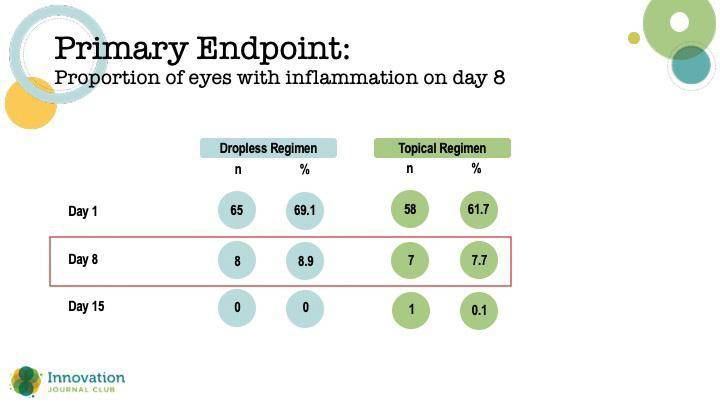
The randomized, prospective, multicenter study enrolled 187 eyes of 94 patients. One eye was randomized as the control (perioperative topical eye drops), while the contralateral study eye received intracameral phenylephrine 1.0%/ketorolac 0.3% and moxifloxacin, and subconjunctival triamcinolone acetonide). The primary endpoint of the trial was the proportion of patients with inflammation on day 8 (Figure).

Secondary endpoints included: mean change in central subfield thickness (no statistically significant difference); number of eyes with cystoid macular edema (no statistically significant difference); patient-reported outcomes (no statistically significant difference); and overall patient satisfaction with the postoperative regimen, where the patients’ preference for the dropless regimen was statistically significant.
Overall, there were few adverse events in either study arm and no statistically significant difference in the proportion of eyes with intra- and postoperative complications (dropless regimen: 37; topical regimen: 40). Of note (and related to the primary endpoint), there were 2 eyes that experienced rebound inflammation requiring rescue therapy (dropless regimen: 1 at day 30 [deemed unrelated to the study]; topical regimen: 1 at day 30 [treated and resolved by day 90]).
Ready to Claim Your Credits?
You have attempts to pass this post-test. Take your time and review carefully before submitting.
Good luck!
Recommended
 IJC Recap: Canaloplasty, Light-Adjustable Lenses, and Dropless Cataract Surgery
IJC Recap: Canaloplasty, Light-Adjustable Lenses, and Dropless Cataract Surgery
I. Paul Singh, MDI. Paul Singh, MD- IJC Recap: Canaloplasty, Light-Adjustable Lenses, and Dropless Cataract Surgery
Comparing Canaloplasty and a Trabecular Micro-Bypass Stent
Damien F. Goldberg, MD, MBADamien F. Goldberg, MD, MBA - IJC Recap: Canaloplasty, Light-Adjustable Lenses, and Dropless Cataract Surgery
Comparing the Clinical Performance of Two LAL Models
John Doane, MDJohn Doane, MD