Small incision lenticule extraction (SMILE), performed using a femtosecond laser (VisuMax; Carl Zeiss Meditec) that is capable of carving out a lenticule within the cornea, is one form of intrastromal refractive surgery. The laser energy of the VisuMax creates plasma-induced photodisruption, resulting in the formation of cleavage planes within the corneal stroma at a predetermined depth with a high degree of precision.1 The lenticule can then be extracted from within the corneal stroma by creating and lifting a hinged flap in a procedure called femtosecond lenticule extraction (FLEX) or via the more popular SMILE procedure, in which the lenticule is extracted through a small incision.
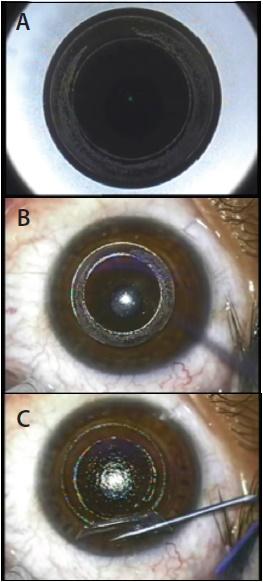
SMILE has become an alternative to LASIK for myopic correction for many surgeons in Europe and Asia (see on the previous page).2,3 It is awaiting FDA approval in the United States pending the results of ongoing clinical trials. The procedure is currently available as a treatment modality for myopic correction of up to -10.00 D spherical equivalent, with a maximum astigmatic error of up to 5.00 D. The selection criteria are similar to those for LASIK. The procedure is currently not capable of hyperopic correction, although research is ongoing for this application.
MANAGING COMPLICATIONS
There are two types of complications that can be encountered intraoperatively, and each can potentially be managed successfully.
Suction loss. This occurs when the contact glass becomes detached from the cornea during the procedure.4 The general challenge in this situation is redocking of the contact glass interface to the eye while still retaining centration. In our experience, repeating the treatment immediately is convenient and does not seem to affect the results of the procedure.
Phase 1: Initial docking with precise centration. During this phase, proper head position is achieved by tilting the patient's head medially to avoid nasal contact with the cone of the contact glass interface. Precise centration should be verified before the initiation of suction.
Phase 2: Femtosecond laser delivery. Femtosecond laser pulses are fired in a spiral pattern with a pulse energy of 120 to 170 nJ and a repetition rate of 500 kHz.
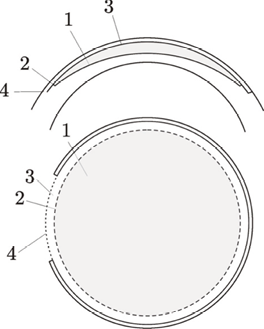
Phase 3: Tissue dissection and lenticule removal. The tissue disruption planes created by the laser include the posterior lenticule surface, vertical edge cut, anterior lenticule surface, and corneal sidecut (Figures 1 and 2).
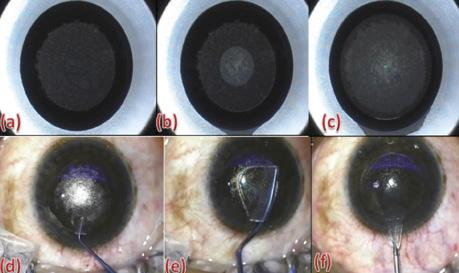
Incorrect dissection. Here, the posterior disruption plane is separated first, resulting in the lenticule being stuck to the undersurface of the cap. In our experience, when this occurs it is still possible, with some surgical dexterity, to separate the lenticule from the overlying cornea. In case this is not possible, the VisuMax allows the creation of a sidecut incision only, and it is best at this point to convert the case into a FLEX procedure by repeating a 270º to 300° sidecut incision.
SMILE OVER LASIK
Several authors have demonstrated superiority of SMILE over femtosecond LASIK in a number of measures. SMILE has been reported to result in lower degrees of induced higher-order aberrations and less reduction in corneal sensitivity than LASIK.5,6
Also, SMILE affects the biomechanical properties of the cornea less than LASIK.7,8 SMILE is a flapless technique, and its effect is predicated on the new concept of tissue subtraction, which is different from tissue ablation achieved with the excimer laser in LASIK.7,8
enhancement technique
No matter how accurate the results of SMILE, no doubt some patients will need enhancement. A recent adaptation of the VisuMax software enables enhancements of SMILE with a procedure known as (Figure 1). With Circle, a previously created cap can be remodeled into a larger diameter hinged flap, and this can be followed by excimer laser ablation to address any residual refractive error. n
Mahipal Sachdev, MD
• Chairman, Medical Director, and Senior Consultant
Ophthalmologist, Centre For Sight, New Delhi, India
• drmahipal@gmail.com
• Financial disclosure: Travel grant (Carl Zeiss Meditec)