
Wide Corneal Epithelial Mapping Using OCT
Controlling the thickness, shape, and growth of the corneal epithelium can minimize the risk of regression.
Since the introduction of laser vision correction (LVC)1 in the form of PRK,2 LASIK,3 or refractive lenticular extraction,4 the stability and persistence of the correction have been a matter of controversy and debate.5 Refractive regression is the term used to describe the loss of the effect of LVC. Regression results in the postoperative refraction deteriorating toward the initial refraction. Although there have been attempts to distinguish topographic/corneal regression (ie, the modified corneal curvature returning toward its preoperative curvature) from refractive progression (ie, the refraction changes due to continued axial length elongation),6 there has been no standardized and universally adopted method to document or study this. Axial length measurement is presently extremely accurate but rarely performed for patients who undergo LVC.
Topographic regression has been often associated with changes in the morphology of the epithelium induced by the alteration in curvature imposed on the underlying change in the stroma as a result of the LVC.7,8
Studies have shown that PRK,9 LASIK,10 and SMILE (Carl Zeiss Meditec)11 are all affected (to different degrees) by the induced epithelial morphological change, most commonly hyperplasia, leading to true topographic regression.
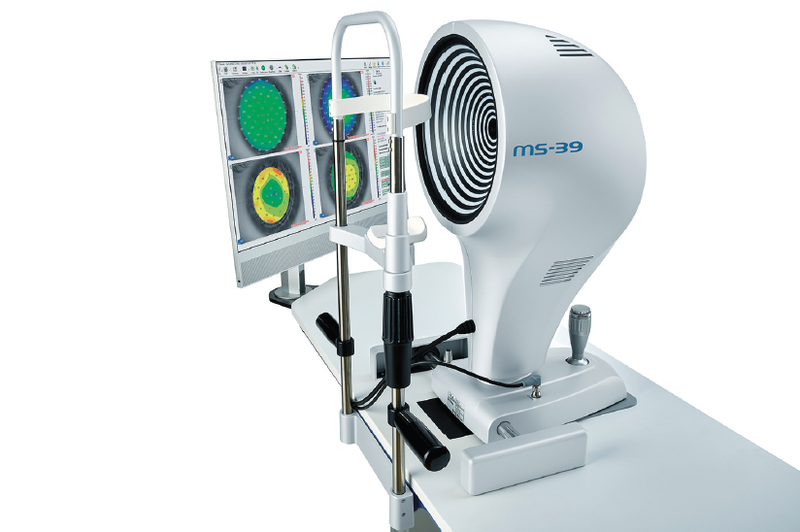
With the advent and refinement of OCT technologies, anterior segment OCT devices have immensely improved the visualization of the corneal epithelium. They have also helped with our understanding of the role the epithelium plays in corneal-induced regression. The device used in the SCHWIND platform is the SCHWIND MS-39,† which incorporates the latest in OCT technology and is combined with the well-established Placido-based topography system (Figure 1). The unique combination makes the SCHWIND MS-39 currently the most advanced diagnostic workstation for corneal work.

OCT tomographers have a much better resolution and signal-to-noise ratio when compared to Scheimpflug scanning slit tomographers. The SCHWIND MS-39 has unprecedented capabilities in 3D imaging of the epithelial thickness (Figures 2 and 3) without the cumbersome ultrasound water bath system. It is easily comparable to the very high frequency ultrasound system. One of the most important features it has is the ability to measure a widefield epithelial map precisely, easily, and quickly.


The short- and long-term stability of LVC has been questioned in the past.12 In particular, PRK seems to be associated with an overshoot followed by a reduction of the overcorrection toward the so-called final refraction.13 This has been considered as part of the procedure. It is the weakness of the PRK procedure when compared to LASIK or lenticule extraction with either SMILE or SmartSight (SCHWIND eye-tech-solutions) in which the so-called final refraction is achieved more rapidly.14 It is the same for hyperopic and myopic correction with hyperopic PRK having the longest recovery time.

There are only a few studies trying to distinguish topographic regression from refractive progression.15 Results from these studies show that the epithelium is responsible for short- to mid-term changes at the anterior corneal surface.9 Epithelial hyperplasia can occur in all forms of LVC.16,17
A study of transepithelial PRK (TransPRK) demonstrated essentially no epithelial thickening at 1-month follow-up.18 Another study using the same LVC platform found that thinner corneal epithelium tended to thicken more after TransPRK. Additionally, patients with preoperatively thicker epithelium tended to thin after TransPRK.19
Surface ablation induces corneal surface roughness due to laser spot size and other factors.20-22 This postoperative irregularity elicits an epithelial response that smooths the corneal surface.23 The regrowth of the epithelium compensates for corneal shape modifications. It also lowers the laser-induced irregularities and overall corneal aberrations.24
Huang et al showed that epithelial thickness modulations after ablation can be modeled mathematically to explain clinically observed regression and induction of aberrations.25 A smooth stromal bed26 after the ablation combined with a large optical zone27 and a wide transition zone 28 produces less remodeling of the epithelium. The prophylactic use of CXL has also been proposed to arrest the effects of epithelial remodeling.29
The epithelial refractive power alone is an average of 1.03 D (range, 0.55–1.85 D) over the central 2-mm zone and 0.85 D (range, 0.29–1.60 D) at the 3.6-mm zone.30 Other reports found lower values for the optical power of the epithelium.31
CONCLUSION
The role of the corneal epithelium in the corneal net power and thus total ocular refraction is gaining more importance. The corneal epithelium is one of the final frontiers of LVC surgery. Controlling its thickness, shape, and growth will make LVC more accurate by minimizing the risk of regression.
Ready to Claim Your Credits?
You have attempts to pass this post-test. Take your time and review carefully before submitting.
Good luck!
Recommended
 Celebrating the Magic of Vision
Yesterday, Today, and Tomorrow: The Changing Face of Modern Refractive Surgery
John Marshall, PHDJohn Marshall, PHD- Celebrating the Magic of Vision
Why We Choose to Be Part of the SCHWIND Family
Carmen José Barraquer Coll, MD; Ángela María Gutiérrez, MDCarmen José Barraquer Coll, MD; Ángela María Gutiérrez, MD