The Necessity of the Femtosecond Laser for Complex Cases

I encourage a mindset of what I call designer cataract surgery, which entails aspiring to achieve each cataract patient’s best visual potential. The femtosecond laser helps me to reach that goal even in complex cases.1-3
AT A GLANCE
• Errant capsulorrhexes prolong surgery and can lead to complications. In complex cases, the capsulotomy is therefore the most useful function of the femtosecond laser in Dr. Gulani’s opinion.
• In certain complex cases, the increased accuracy and precision of a laser capsulotomy compared with a manual capsulorrhexis can make the difference between an excellent and a poor visual outcome.
Although some surgeons continue to debate the benefits of femtosecond lasers for uncomplicated cataract procedures, I believe the technology is almost a necessity in certain complex scenarios. To me, the most important use of the laser is for the creation of the capsulotomy.4 It is this step of the cataract procedure that can pose the greatest challenge and risk in certain complex cases.5-8 Errant capsulorrhexes can prolong surgery, require a change in plans, and lead to complications such as persistent uveitis, cystoid macular edema, and secondary retinal detachment.9,10
Moreover, an irregularly shaped capsulotomy may influence the position of the IOL, leading to decentration and tilt that can decrease the patient’s quality of vision. The consistency of the laser capsulotomy can, therefore, be highly advantageous.
This article shares just three cases of many in which I found the femtosecond laser to be nearly indispensable.
Case No. 1: Torn Posterior Capsule After Retinal Surgery And White Cataract
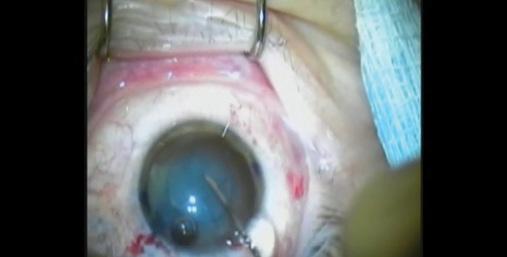
A patient was referred to me with a dense white cataract and hand motions vision. A retina specialist had previously accidentally torn the posterior capsule while injecting an antivascular endothelial growth factor medication. The consistency of the laser for creating a capsulotomy allowed me to plan for a sulcus-based IOL, and the patient achieved a UCVA of 20/25 (Figure 1).
Case No. 2: Cataract and Central Herpetic Corneal Scar With a Divot
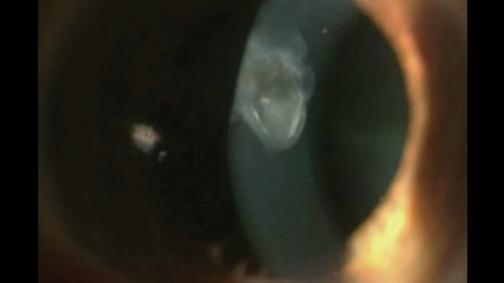
I performed in-cornea laser corneoplastique on the eye of a patient with a dense, central, herpetic corneal scar and a preoperative BCVA of 20/150 (Figure 2). He was so happy with his postoperative visual acuity of 20/30 that he delayed his cataract procedure. When he presented for cataract surgery, I executed a two-step strategy, with aphakic cataract surgery followed 1 week later by the refraction-based implantation of a toric IOL (acknowledgement of Richard Mackool, MD). The patient’s UCVA improved to 20/25. The perfect, well-sized, central capsulotomy was crucial to the outcome.
Case No. 3: Nystagmus and Mature Cataract
A well-planned and well-executed capsulorrhexis in an eye with a mature cataract not only sets the stage for surgery but also decompresses the capsular bag, thus avoiding the Argentinian flag sign.
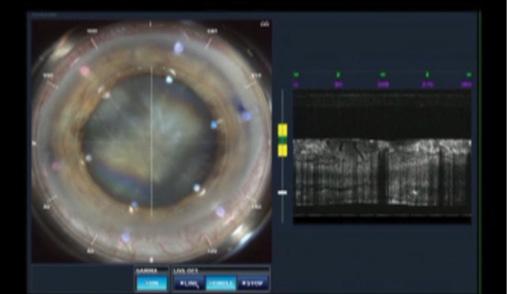
I recently treated an optician with nystagmus and a mature cataract. As I waited to dock the laser, the speculum and the patient’s eye were moving constantly. As soon as I could center the eye, I applied suction, thus controlling the nystagmus (Figure 3). Having accomplished the capsulotomy, I was then able to proceed with cataract surgery, which achieved a UCVA of 20/25.
Case No. 4: Nystagmus, High Hyperopia, Fuchs Dystrophy, Small Pupils, Mature Cataract, Narrow Angle, and Shallow Anterior Chamber
An even more complex case I recently treated is a patient with nystagmus, high hyperopia (9.00 D sphere), Fuchs dystrophy, small pupils, mature cataract, narrow angle, and a shallow anterior chamber. He was also hearing impaired and had head tremors and a tracheostomy. Because the patient could not hear or speak, I knew it would be hard for him to follow my verbal orders during surgery. His head tremors caused his eyes to constantly move, which, with his very shallow anterior chamber and hypermature white cataract, would make my capsulorrhexis perilous.
Using the femtosecond laser, I was able to stabilize the patient’s moving eyes by docking him to the interface, allowing me to create a predictable capsulotomy. Thereafter, surgery was routine, leading to a predictable outcome that changed his life forever.
CONCLUSION
In complex cases such as these I have described, laser technology provides the advantage of a predictable, consistent capsulotomy. Surgical outcomes can never be guaranteed, but the increased accuracy, predictability, and precision afforded by the laser can make the difference between an excellent and a poor visual outcome for these patients.
Arun C. Gulani, MD, MS
• Founding Director, Chief Surgeon, Gulani Vision Institute, Jacksonville, Florida
• gulanivision@gulani.com
• Financial disclosure: None provided
Ready to Claim Your Credits?
You have attempts to pass this post-test. Take your time and review carefully before submitting.
Good luck!
Recommended
- Cataract Surgery
More Than 20 Radial Keratotomy Incisions
Audrey Rostov, MD; Jorge L. Alió, MD, PhD, FEBOphth, FWCRSAudrey Rostov, MD; Jorge L. Alió, MD, PhD, FEBOphth, FWCRS