Managing Dry Eye Issues in Refractive Surgery Patients


One of the main reasons for dissatisfaction after refractive surgery is symptoms of dry eye. These are said to occur in up to half of patients after LASIK.1-3 Several groups have reviewed the diagnoses of patients referred to them with problems after refractive surgery. Jabbur et al reported on 143 eyes, of whom more than 80% had LASIK and most of the rest had PRK.4 They reported that 21% of patients complained of dry eye symptoms and 30% were diagnosed with dry eye disease (DED). Our group at Wills Eye Hospital reported on 157 eyes seen with complaints after LASIK.5 The vast majority complained of poor distance UCVA, but 19% complained of dry eyes. Dry eyes and/or blepharitis were diagnosed in 28% of eyes. More recently, Patryn et al reported on 131 eyes referred for problems after refractive surgery, including more than 80% after corneal refractive surgery.6 DED was diagnosed in 23% of these eyes.
Dry eyes are not only uncomfortable; they can also cause poor and fluctuating vision. Needless to say, dry eye complaints can be frustrating for both patients and surgeons. There are a variety of issues to consider when attempting to address this problem, including whether refractive surgery patients are predisposed to DED, whether certain refractive surgery procedures cause more dry eye symptoms than others, what can be done preoperatively to decrease the risk of postoperative dry eye symptoms, and, finally, which treatments work best when a patient is bothered by dry eye symptoms postoperatively.
PREDISPOSED TO DRY EYE?
Patients typically seek refractive surgery when they are not satisfied with their vision in glasses and/or contact lenses. A major reason for inability to wear contact lenses or for contact lens intolerance is dry eyes, due to the natural aging process and/or to chronic contact lens wear. Consequently, many patients seeking refractive surgery have underlying dry eye issues.
I ask all patients why they want refractive surgery, and if they say they cannot wear contact lenses or they are having decreased comfort with their contact lenses, I suspect some element of DED.
At the preoperative refractive surgery evaluation, I ask patients about contact lens tolerance as above and also about other symptoms of dry eye. Some refractive surgeons give all patients a standardized dry eye questionnaire such as the Ocular Surface Disease Index (OSDI). On examination, I look at the tear meniscus and evaluate ocular surface staining and tear breakup time with fluorescein dye. If there are symptoms or signs of dry eye, I then place lissamine green dye and look for conjunctival staining. A Schirmer test can aid in determining the patient’s ability to produce tears. A tear osmolarity test can also be helpful, but this must be done prior to instilling all other drops. Another tear test, for matrix metalloproteinase 9 (MMP-9), can reveal high levels of inflammation in the tear film, but it can also be affected by previous administration of drops. I also pay close attention to the health of the meibomian glands.
At a Glance
• At the preoperative refractive surgery evaluation, consider asking patients about contact lens intolerance and other symptoms of dry eye and using a standardized dry eye questionnaire.
• If a patient has evidence of preoperative DED, try to identify whether it is more an aqueous-deficient or evaporative condition and treat accordingly.
• Be cautious about performing refractive surgery in patients with dry eyes preoperatively, as there is an association with postoperative dry eye symptoms after refractive surgery.
• Take patients’ dry eye complaints seriously and treat patients with empathy.
TREATING PREOPERATIVELY
If a patient has evidence of preoperative dry eye, I try to identify whether it is more an aqueous-deficient or evaporative dry eye condition and treat accordingly. For aqueous-deficient DED, I may prescribe preservative-free tears, cyclosporine 0.05% (Restasis; Allergan) twice daily,7,8 insertion of silicone punctal plugs, dietary supplementation with omega-3 fatty acids, and tear gel or ointment at bedtime. For evaporative DED, I generally recommend warm compresses for 5 minutes once or twice daily, commercial lid scrubs once or twice daily, antibiotic gel or ointment at bedtime, omega-3 supplements, and, occasionally, heat and pressure treatment of the eyelids with LipiFlow (TearScience).
As most patients have a combination of aqueous-deficient and evaporative DED, I generally treat for both. When I prescribe cyclosporine 0.05% drops, I often also start a short course of topical steroids such as loteprednol etabonate 0.5% (Lotemax; Bausch + Lomb) twice daily for 2 weeks, then once daily for 2 weeks. In some patients with meibomian gland dysfunction, I may also start a short course of topical antibiotic-steroid such as loteprednol-tobramycin (Zylet; Bausch + Lomb) once or twice daily for a few weeks.
If I am treating a patient for preoperative ocular surface disease, I schedule the patient to come for a second visit about 4 to 6 weeks later. This is for three main reasons. One reason is to make sure the dry eye condition has improved to the point that the patient is now a good candidate for refractive surgery. Second is to repeat the patient’s refraction and topography/tomography testing to make sure I have accurate and stable measurements. (If the ocular surface does not appear healthy enough for surgery or the measurements are not good, I postpone surgery and see the patient in another few months. Otherwise, I often feel I can proceed with refractive surgery, and I have the patient continue the preoperative treatment regimen for at least 3 months postoperatively.) Third is that the repeat visit is a means to reinforce that the patient had dry eye problems preoperatively and to remind the patient that he or she should note if and when dry eye symptoms increase postoperatively.
WHICH REFRACTIVE PROCEDURES CAN INDUCE DRY EYE?
I am cautious about performing refractive surgery in patients with dry eyes because preoperative dry eye is associated with postoperative dry eye symptoms after refractive surgery. It is known that refractive surgery can itself cause dry eye symptoms. Since the early days of excimer laser refractive surgery, both PRK and LASIK have been associated with increased dry eye symptoms after surgery. While many, if not most, refractive surgeons have the sense that LASIK tends to cause more dry eye issues than PRK or other surface ablation procedures, the data are mixed. Lee et al found more dry eye problems after LASIK than PRK.9 Dooley et al found increased dry eye symptoms 3 months after LASIK but not after surface ablation using LASEK.10 Murakami and Manche found increased dry eye symptoms at 1, 3, and 6 months after both LASIK and PRK, but symptoms returned to baseline preoperative levels in both groups by 12 months.11
There are numerous theories as to why this condition occurs: The new corneal curvature may not maintain a smooth tear film, the microkeratome may damage to goblet cells, these procedures may cause a neurotrophic keratopathy,3,12 and/or it may be a combination of these and possibly other factors.
The effect of hinge location has been widely studied, as have the relative effects of mechanical microkeratome and femtosecond laser flaps on dry eye signs and symptoms after LASIK; these studies have also yielded conflicting results. Initially, a superior LASIK hinge was thought to induce worse dry eye symptoms due to the transection of the long posterior corneal nerves that enter at the 3- and 9-o’clock positions.13 Later studies, however, found minimal or no differences due to hinge location.14-17 In another study, greater LASIK hinge width was associated with more dry eye signs and symptoms.18 Also, some studies have demonstrated less dry eye with femtosecond laser than with microkeratome flaps, whereas others have not.19-21 One study found that femtosecond LASIK flap thickness and hinge angle did not influence corneal sensation or dry eye signs or symptoms.15 Another found that, although an inverted 130º femtosecond laser sidecut was associated with faster recovery of corneal sensation compared with a conventional 70º sidecut, this did not translate into an improvement in subjective dry eye symptoms.22 Other risk factors for dry eye signs and symptoms after myopic LASIK include the degree of preoperative myopia being treated and the depth of laser treatment.2,14
POSTOPERATIVE TREATMENT
Many patients experience dry eye symptoms after corneal refractive surgery. I tell all patients to expect mild to moderate dry eye symptoms for weeks to a few months postoperatively. I prescribe frequent preservative-free artificial tears to all patients for a minimum of 3 months postoperatively. If they have significant superficial punctate keratitis for more than 1 to 2 weeks postoperatively, I place punctal plugs and/or prescribe cyclosporine 0.05% twice daily and add a tear ointment at bedtime if one is not already being used.23-26 Omega-3 supplements may also be helpful. Treatment of blepharitis should be started as needed. Although diquafosol is not available in the United States, this topical drop has been used to successfully treat post-LASIK dry eyes in other countries.27,28
Fortunately, the signs and symptoms of dry eyes after corneal refractive surgery tend to improve with time in the vast majority of patients. In the future, corneal refractive surgical procedures may cause fewer dry eye signs and symptoms. For example, small incision lenticule extraction (SMILE) has been associated with fewer dry eye symptoms than LASIK.29,30
CONCLUSION
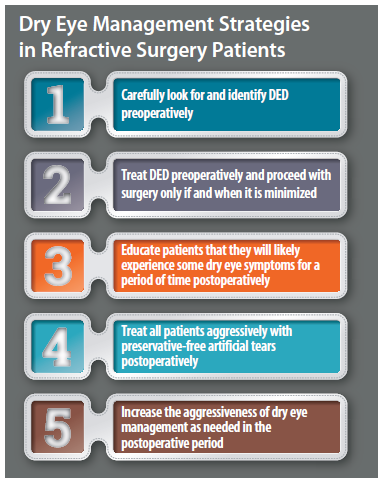
Corneal refractive surgery is extremely successful from the standpoint of both improving UCVA and providing patient satisfaction.31-34 Having said that, postoperative dry eye is a negative issue for many patients. It is best managed by following the guidelines outlined in Dry Eye Management Strategies in Refractive Surgery Patients.
Most important, it is crucial to take patients’ dry eye complaints seriously and treat patients with empathy. Although it is tempting to label these patients as complainers and spend as little time as possible with them, this approach is not good for the patient or the doctor. Taking extra chair time with these patients in the early postoperative period is important so that they do not feel abandoned. Almost all of these patients will improve with appropriate treatment and time, and they will remember your excellent and compassionate care and become your greatest supporters. n
Christopher J. Rapuano, MD
• Chief, Cornea Service, and Co-Chief, Refractive Surgery Department, Wills Eye Hospital, Philadelphia
• Professor of Ophthalmology, Sidney Kimmel Medical College at Thomas Jefferson University, Philadelphia
• cjrapuano@willseye.org
• Financial disclosure: Consultant (Allergan, Bausch + Lomb/ Valeant, Bio-Tissue, Nicox/Valeant, Shire, TearLab, TearScience), Lecture board (Bausch + Lomb/Valeant, Bio-Tissue, TearScience), Stock ownership (RPS)
Ready to Claim Your Credits?
You have attempts to pass this post-test. Take your time and review carefully before submitting.
Good luck!