



Minimally invasive glaucoma surgery (MIGS) trabecular meshwork (TM) bypass procedures are now commonly performed when glaucoma patients undergo cataract surgery. A combined cataract/MIGS procedure provides the patient with the benefits of both surgeries, typically with little additional risk when cataract surgery is already planned. However, standalone TM bypass has been less common. Here, we provide our personal views regarding which types of patients may benefit from standalone TM bypass.
Why consider a standalone intervention?
In many cases, we intervene because the target IOP has not been achieved with current therapies and/or the patient has continued to lose visual field (VF) or sustain optic nerve damage despite IOP control. However, the goal of reducing dependence on topical therapy is also compelling for many patients.
Historically, we would treat patients with up to 4 medications before considering that “maximal” medical therapy and moving on to a surgical option. Today, with the availability of less invasive surgical interventions that have good safety profiles, it is worth considering surgery if the patient has ocular surface toxicity or does not respond sufficiently to one or two topical agents.
For those who are already on multiple topical drops, reducing the number and frequency of medications has the potential to improve quality of life and preserve the ocular surface. A healthy ocular surface will promote successful bleb surgery in the future, should that become necessary. Additionally, TM bypass may be able to reduce IOP fluctuations. For all of these reasons, reducing dependence on topical therapy may be sufficient justification for considering a standalone MIGS intervention in selected patients.
There is already evidence that early intervention can protect patients’ vision. Five years after undergoing combined cataract surgery-TM bypass in the HORIZON trial, patients had a 47% lower rate of VF progression than those who had undergone cataract surgery alone.1
Ideal Candidates for Standalone TM Bypass
The ideal candidate for a standalone TM bypass procedure is a patient with mild to moderate glaucoma who has not achieved the target pressure or for whom additional intervention is desired to slow progression or reduce medication burden. We prefer a patient who is not progressing but at risk of progression, who has a target pressure in the high teens (consistent with mild/moderate disease), has a sufficiently open angle, and is naïve to incisional surgery. They may be phakic or pseudophakic, and prior SLT should not be considered a contraindication. Each of these patient characteristics is discussed in more detail below.
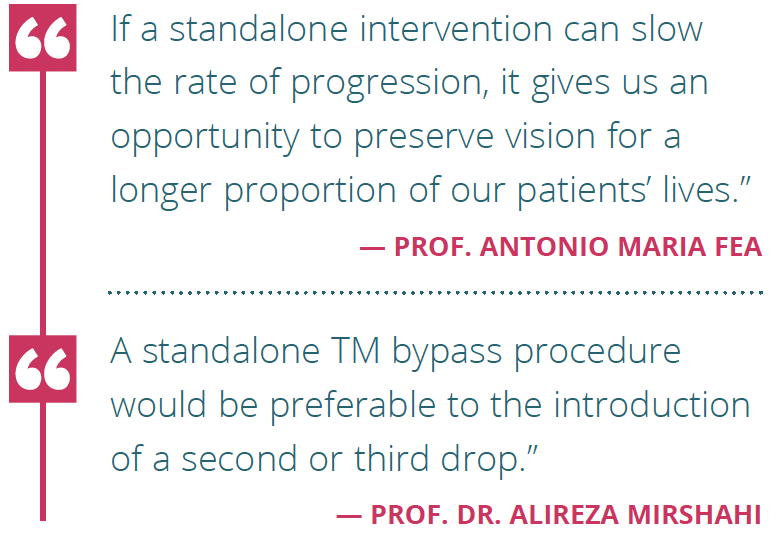
Mild to moderate disease
The risks of a standalone intervention are acceptable only when you expect the patient to benefit. If the glaucoma is well controlled with no significant ocular surface problems, intervention isn’t necessary. At the other extreme, we have all seen cases where there is a clear need for filtration surgery. But there are many patients who fall in-between these clearly defined choices, where one would like to achieve additional pressure lowering but the need to do so is not so great that it is worth exposing the patient to the potential complications of filtration surgery.
For these patients in the middle, a less invasive MIGS procedure could be advantageous, as long as one is reasonably confident of its ability to achieve the target IOP and truly avoid filtering surgery. In more advanced glaucoma, the results of TM bypass are much less predictable. It may not be possible to reduce IOP enough to arrest progression or the patient’s outflow pathway may be so compromised that it will not respond to the TM bypass.
Slower rate of progression
When a patient is experiencing a rapid rate of progression, they can’t afford to wait to see if less invasive measures work well enough. The challenge for the glaucoma surgeon is to find a procedure that is likely to achieve the low target IOP which is needed in these patients. Patients with a rapid rate of progression should have filtering surgery, despite the invasiveness and risks of complications. The risk of a failed MIGS intervention is higher, so this patient is not a good candidate for TM bypass.
A reasonable starting and target IOP
Patients with either very high or very low baseline IOP may be poor candidates for a standalone bypass procedure.
The Goldmann Equation tells us that the higher the baseline IOP, the more that an intervention—whether that be MIGS or cataract surgery—will lower the pressure. However, even a mild to moderate reduction in IOP may be insufficient to reach the desired target IOP in the setting of a baseline IOP >30 mmHg. Furthermore, in eyes with very high IOP, not only the trabecular meshwork but also the collector channels and Schlemm's canal may be compromised. Years of mechanical stress have likely induced inflammation and damaged Schlemm’s canal. At that stage, simply opening up the TM may not adequately lower IOP.
And in patients with IOP already in the physiologically normal range, one cannot expect significant IOP lowering. The effects will be limited by episcleral venous pressure, which provides a floor effect for IOP. However, in these patients, TM bypass may be reasonable if the goal is to eliminate medications rather than to reduce IOP.
Naïve to incisional procedures
Prior history of glaucoma procedures should be carefully considered when contemplating a standalone trabecular bypass. Although more research is needed to explore the influence of prior SLT on trabecular bypass MIGS outcomes, in our experience patients who have failed SLT, or initially responded but now need additional pressure lowering, remain good candidates for TM bypass.
However, pseudophakic patients with a previous TM bypass procedure at the time of cataract surgery and patients with a history of filtration surgery should probably be avoided. Previous TM procedure failure may indicate that certain characteristics make the patient poorly suited for a MIGS TM bypass approach. Prior filtration surgery may lead to degenerative changes in the TM such that procedures which target physiological outflow pathways may be less effective. While there may be some cases in which TM bypass would be successful, we cannot have a high level of confidence that it will be effective for most patients in this category.
Pseudophakic or phakic
Pseudophakic patients who have not had prior glaucoma surgery likely make up the largest population of candidates for standalone trabecular bypass. Many surgeons are comfortable performing standalone MIGS in the majority of this small group of patients because the risk is lower than with filtration surgery and therefore it is worth trying the safer, less invasive procedure, even if the chance of success is lower or unknown.
For the phakic patient, we have a responsibility to protect the integrity and transparency of the crystalline lens. Efficacy is also a significant consideration in these younger, phakic patients. If the need for intervention is great enough that surgery is being considered, one may want to maximize the chance of success with a single intervention and, based on the current evidence, that would likely be a bleb-forming procedure. However, there is a growing body of research on TM bypass in phakic eyes2-4 and several of us are quite comfortable performing TM bypass in phakic patients and simply avoiding capsular touch (Miotic use is advisable). Additionally, the shorter duration of corticosteroid use with a MIGS procedure may reduce the chance of steroid-induced posterior capsular cataract compared to more invasive surgeries. One barrier to optimal decision making in phakic patients is that the true risk of cataract from a standalone MIGS procedure has not yet been well characterized. It is also largely unknown whether future cataract surgery might affect the outflow pathway in a way that reduces the success rates of TM bypass surgery.

A Changing Paradigm
There is a growing consensus that standalone TM bypass can benefit patients who need additional IOP lowering or relief from medication burden, but who are not good candidates for filtering surgery. For those with an interventional glaucoma mindset, standalone TM bypass should be considered, for appropriate candidates, among the menu of potential interventions. Country-specific health care models may affect practice patterns and surgeons’ thresholds for intervention. Additionally, the setting (public or private hospital) may also influence treatment decisions.

The choice of which TM bypass procedure to perform should be based on the degree of invasiveness, surgical time and complexity, and speed of recovery. Physicians or patients may prefer to avoid having an implanted stenting device due to the risks of migration or occlusion. If these devices are placed improperly, their utility is compromised; surgeon comfort with gonioscopy and implant manipulation should therefore be carefully considered.
The impact of surgery on endothelial cell density (ECD) is expected to be significantly less with any MIGS procedure than with more invasive filtration procedures. However, one suprachoroidal MIGS implant has been removed from the market due to an unacceptable impact on ECD, so it is important to learn more about the effects of each TM bypass procedure on the corneal endothelium. Larger implants are associated with a greater ECD impact and should probably be avoided in patients with guttata, a prior corneal transplant, or other corneal disease.

Certainly, gaps in the scientific evidence remain. These gaps include whether TM bypass is as effective in secondary glaucoma as in primary glaucoma; whether all types of TM bypass can slow progression; and the relative long-term IOP lowering efficacy of stent versus laser TM bypass procedures. As more clinical experience is gained and additional scientific evidence emerges, we expect that paradigms for the use of TM bypass as a standalone procedure will be further clarified for the benefit of physicians and patients alike.
FACTORS IN TM BYPASS PROCEDURE CHOICE
- Potential for implant-related complications
- Technical difficulty of procedure
- Degree of tissue disruption
- Speed of recovery
- Duration of postoperative steroids
- Rate of endothelial cell loss associated with the procedure
- Cataract risk
- Patient preferences
1. Montesano G, Ometto G, Ahmed IIK, et al. Five-year visual field outcomes of the HORIZON trial. Am J Ophthalmol 2023;251:143-155.
2. Vold SD, Voskanyan L, Tetz M, et al. Newly diagnosed primary open-angle glaucoma randomized to 2 trabecular bypass stents or prostaglandin: Outcomes through 36 months. Ophthalmol Ther 2016;5(2):161-172.
3. Kiramira D, Voβmerbäumer U, Pfeiffer N, et al. Mid-term real world outcomes of the Hydrus Microstent in open angle glaucoma. Eye (Lond) 2024;38(8):1454-61.
4. Lindstrom R, Lewis R, Hornbeak DM, et al. Outcomes following implantation of two second-generation trabecular micro-bypass stents in patients with open-angle glaucoma on one medication: 18-month follow-up. Adv Ther 2016;33(11):2082-90.
The views and opinions expressed here may not necessarily reflect those of Bryn Mawr Communications or Cataract & Refractive Surgery Today Global.


