



The HORIZON trial, a phase 3 clinical trial that compared Hydrus® Microstent (Alcon) + cataract surgery (CS) to CS alone, was the largest minimally invasive glaucoma surgery (MIGS) pivotal trial conducted to date, with 38 sites in nine countries.1-3 Approximately 40% of the Hydrus® patient population came from outside the United States. For the study, patients with mild-to-moderate primary open-angle glaucoma (POAG) on one to four medications underwent CS and then were randomized 2:1 to Hydrus® Microstent placement (n = 369) or CS alone (n = 187).1 The primary endpoint of the study was the percentage of patients with a 20% or greater reduction in washed-out diurnal intraocular pressure (DIOP) after 2 years of follow-up. The main secondary endpoint was the change in washed-out DIOP at 2 years.1 In the second phase of the study, patients were continuously followed for an additional 3 years to monitor safety outcomes and to assess predefined efficacy endpoints.2,3 Notably, approximately 80% of patients (n = 442/556) originally enrolled to receive Hydrus® Microstent were followed to the 5-year study endpoint.3
The Pivotal Phase: Year 2 Data
The study met its primary endpoint at 2 years (Figure 1).1 The mean reduction in mean washed-out DIOP at 2 years was -7.6 ±4.1 mm Hg and -5.3 ±3.9 mm Hg in the Hydrus® + CS group and CS alone group, respectively (difference = -2.3 mm Hg; P <.001). The mean number of medications was reduced from 1.7 ±0.9 to 0.3 ±0.8 in the Hydrus® + CS group and from 1.7 ±0.9 to 0.7 ±0.9 in the CS alone group (difference = -0.4 medications; P <.001).1
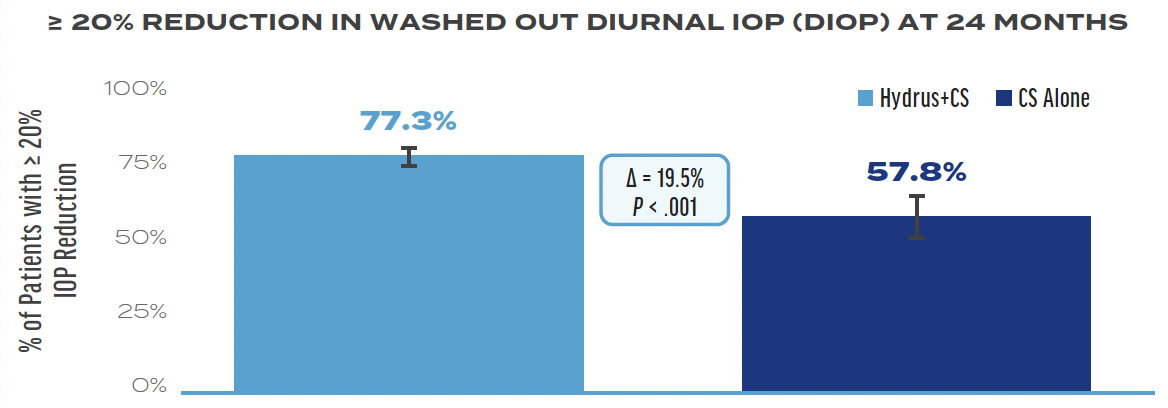
Figure 1. A greater percentage of patients achieved ≥ 20% reduction in washed-out diurnal IOP at 24 months in the Hydrus® Microstent + cataract surgery (CS) group compared to CS alone, which was the primary endpoint in the HORIZON trial.1
As for safety, there was a low percentage of adverse events overall. Postoperative cell and flare were more common in the Hydrus® + CS group in the first week, but all cases resolved within the first month.1 The most common adverse event reported in the Hydrus® + CS group was peripheral anterior synechiae (PAS) or iris tissue near the inlet; these were considered obstructive in 14 of 369 (3.8%) affected eyes and nonobstructive in 55 of 369 (14.9%) eyes. The investigators noted that observation of PAS or adhesion did not affect the outcome.1
Extended Follow-Up: Year 5 Data
The percent of subjects with reported serious adverse events was 3.5% in the Hydrus® + CS group (n = 13/369) and 4.3% in the CS alone group (n = 8/187).3 There was no difference from year 2 to 5 in secondary safety outcomes, except for the rate of PAS, which was significantly higher at 5 years in the Hydrus® + CS group (14.6%) compared to CS alone (3.7%; P = .0001). However, the majority of eyes with PAS in the Hydrus® Microstent group (8.7%) were not device obstructing, and there was no difference in IOP between patients with (16.9 ±3.3 mm Hg) and without PAS (16.6 ±3.5 mm Hg; P = .49). In the majority of eyes with PAS (30/42; 71.4%), PAS were focal or less than 1 clock hour in size. There was no impact on IOP or visual acuity due to PAS, and there were no sequelae observed in eyes with device obstruction.3
The investigators observed a 2% between-group difference in mean central endothelial cell density (ECD) at 3 months postoperatively (11% rate of endothelial cell loss [ECL] CS alone vs 13% ECL Hydrus® + CS; P = .08). The difference may be attributable to the additional manipulation required when inserting the Hydrus® Microstent. The between-group difference increased to 6% over 5 years (13% ECL CS alone vs 19% ECL Hydrus® + CS), but the difference was not statistically significant (Figure 2).3
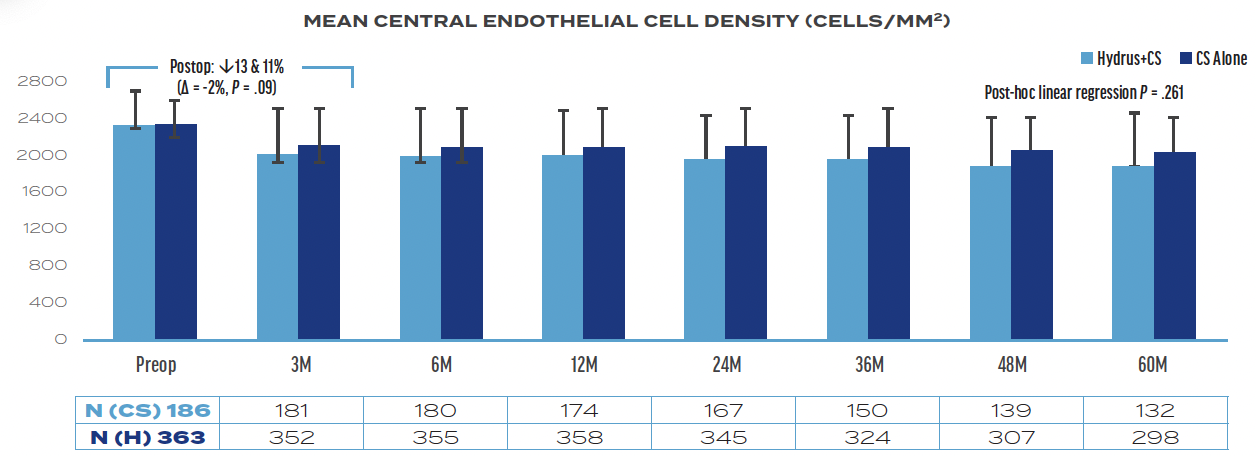
Figure 2. Mean central endothelial cell density in the Hydrus® + cataract surgery (CS) and CS alone groups at 5 years in the HORIZON trial.3
In addition to ECD values alone, the rate of change of ECD was also looked at. In the study, the year-to-year ECL ranged from zero to 2% in the Hydrus® + CS group and zero to 1% in the CS alone group. There was no statistically significant difference in the rate of ECL from 3 months to 5 years in either group, and there was no shift toward increased ECL in years 4 or 5 compared to prior years. Of note, at the 5-year follow-up, the proportion of eyes with ≥ 30% ECL increased from 17.3% at 3 months to 20.8% (P = .27) in the Hydrus® + CS group and from 9.4% at 3 months to 10.6% (P = .85) in the CS alone group. Logistic regression showed no difference in the rate of change of ≥ 30% ECL between the Hydrus + CS group compared to the CS alone group from 3 months to 5 years (P = .82). Furthermore, no eyes with ≥ 30% ECL in the Hydrus® + CS or CS alone groups had associated clinical sequelae.3
As for secondary effectiveness outcomes, a higher percentage of patients achieved medication-free status with Hydrus® + CS versus CS alone (Figure 3),3 and Hydrus® + CS was associated with a reduction in the rate of secondary incisional surgery (Figure 4).3

Figure 3. A higher percentage of patients in the Hydrus® Microstent + cataract surgery (CS) group achieved medication-free status at 5 years compared to the CS alone group.
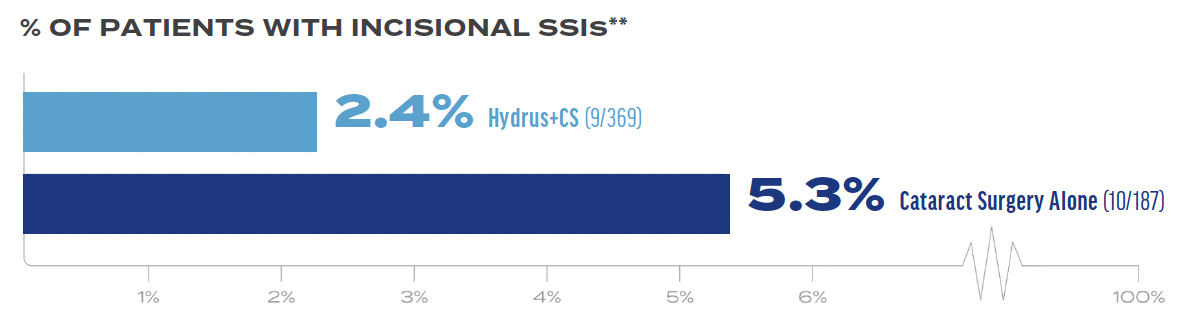
Figure 4. Hydrus® Microstent + cataract surgery (CS) delivered a 50% reduction in incisional secondary surgical interventions (SSIs) compared to CS alone.3 **Secondary Surgical Intervention (SSI) include trabeculectomy, tube shunt, gel stent, ECP/TSCP, non-penetrating; (9/369 Hydrus and 10/187 CS).
1. Samuelson TW, Chang DF, Marquis R, et al; HORIZON Investigators. A schlemm canal microstent for intraocular pressure reduction in primary open-angle glaucoma and cataract: The HORIZON Study. Ophthalmology. 2019;126(1):29-37.
2. Ahmed IIK, Rhee DJ, Jones J, et al; HORIZON Investigators. Three-year findings of the HORIZON Trial: a schlemm canal microstent for pressure reduction in primary open-angle glaucoma and cataract. Ophthalmology. 2021;128(6):857-865.
3. Ahmed IIK, De Francesco T, Rhee D, et al; HORIZON Investigators. Long-term outcomes from the HORIZON Randomized Trial for a schlemm’s canal microstent in combination cataract and glaucoma surgery. Ophthalmology. 2022;129(7):742-751.
4. Alcon Data on File, 2024.
5. HYDRUS® Microstent [instructions for use]. Irvine, CA: Alcon Vision LLC; September 2021 (United States).


