



CASE PRESENTATION
A 63-year-old man presents with blurry vision. The patient is a large boat captain by trade and reports worsening glare and halos at night over the past 3 years. His history is significant for four-cut radial keratotomy (RK) in both eyes followed in the 2000s by bilateral LASIK.
On presentation, the patient’s BSCVA is 20/50 OU, and his BCVA with soft contact lenses is 20/25 OU. His visual acuity with a Brightness Acuity Tester (Marco) is 20/400 OU.
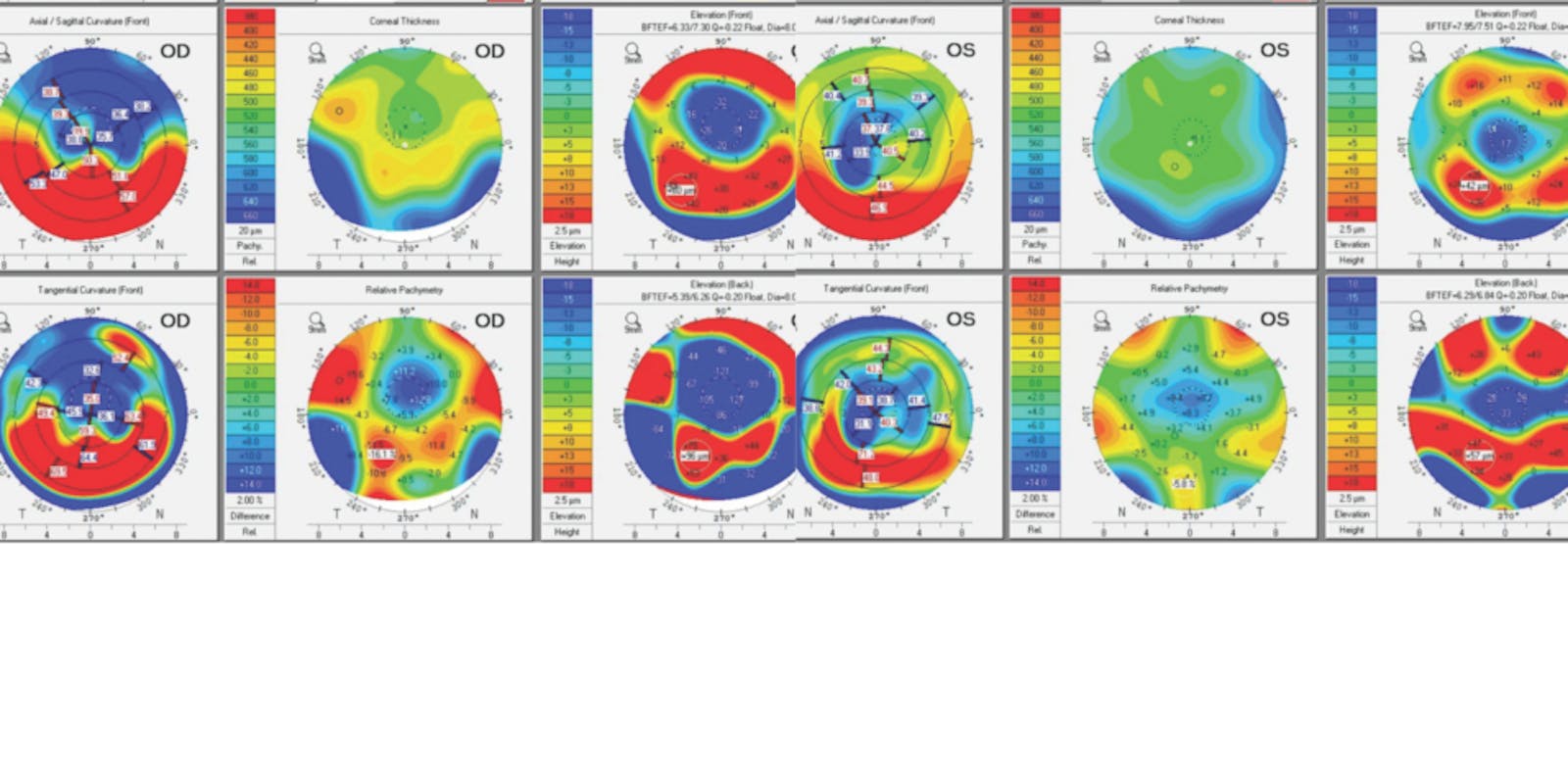
An examination finds mild meibomian gland dysfunction, no corneal staining, and 1+ cortical and nuclear sclerotic cataracts in each eye. Testing with the Pentacam (Oculus Optikgeräte) reveals significant irregular astigmatism and higher-order aberrations (HOAs), greater in the right than left eye (Figure 1). After being counseled on his cataracts and irregular astigmatism, the patient agrees to a trial of rigid gas permeable (RGP) or scleral contact lenses to assess whether his loss of visual function is due to cataracts or corneal changes.

Figure 1. Pentacam measurements for the right (A and C) and left (B and D) eyes obtained at the first consultation.
When he returns to the office 2 months later, his BCVA is 20/20-1 OD and 20/25-1 OS with an RGP contact lens overrefraction. Although he visited his optometrist, the patient found hybrid, RGP, and scleral contact lenses too uncomfortable to wear. His left eye is strongly dominant. After a monovision trial, he expresses interest in undergoing cataract surgery with a mini-monovision strategy but says he must wait until after the busy season at work.
The patient returns for preoperative measurements 1.5 years later. His BCVA with a soft contact lens is 20/30 OD and 20/50 OS. His biometry measurements are shown in Figure 2.

Figure 2. Biometry measurements obtained approximately 20 months later.
How would you proceed? Which IOL(s) would you consider and why? How would you counsel the patient?
— Case prepared by Ryan G. Smith, MD, and Audrey Rostov, MD


GILLES LESIEUR, MD, AND PAUL DUPEYRE, MSC
This complex case includes a significant decrease in quality of vision due to HOAs that are more pronounced in the right eye than the left eye (3.955 vs 2.288 µm) and a decentered optical zone, likely secondary to RK followed by LASIK.
Given the patient’s profession, his functional visual needs—particularly night vision and contrast sensitivity—must be prioritized during IOL selection. His complaint of progressively worsening glare and halos in combination with irregular astigmatism makes selecting a refractive target complicated.
We would use a staged approach. First, cataract surgery with a small-aperture IOL (IC-8 Apthera, Bausch + Lomb) would be performed on the nondominant right eye. The Apthera leverages the pinhole effect to extend depth of focus and mitigate the impact of corneal HOAs, which can be highly beneficial for patients with corneal irregularity due to prior refractive surgery. A functional mini-monovision strategy targeting mild myopia (-0.75 to -1.00 D) would be used to minimize his spectacle dependence while avoiding disruptive anisometropia. Given the patient’s intolerance of RGP and scleral contact lenses and his sensitivity to visual phenomena, we feel this conservative approach would be both practical and safe.
Surgery would be performed on the second eye once he is ready to proceed. Our preference would be a toric lens featuring a zonal refractive design such as the Tecnis Eyhance (Johnson & Johnson Vision) or the Rayner EMV (Rayner). This category of lenses increases range of vision with minimal impact on contrast sensitivity, making the implants an advantageous choice for patients with irregular corneas when diffractive multifocal IOLs are contraindicated.
Our approach would prioritize the patient’s functional vision, HOA tolerance, and lifestyle while respecting his work constraints and avoiding technologies that could exacerbate halos or decrease his contrast sensitivity.

CLAUDIA PEREZ-STRAZIOTA, MD
Regardless of the surgical plan, I would counsel the patient that refractive predictability is limited and that there is a meaningful risk of a postoperative refractive surprise and future topographic progression.
Both eyes have significant irregular astigmatism and topographic evidence of postoperative ectasia, which is more pronounced in the right eye. The irregular astigmatism has created a multifocal corneal surface—a clear contraindication for a multifocal IOL. The refractive instability is increased by unpredictable corneal changes and long-term diurnal fluctuations from the RK incisions.
If quality of vision with or without correction is the patient’s top priority, I would recommend RGP contact lens wear (with a fitting reattempted preoperatively) after cataract surgery with a nontoric monofocal lens. Given the corneal ectasia and because a laser enhancement is not an option, I would avoid a monovision strategy because a stable refractive endpoint cannot be guaranteed.
If the patient is highly motivated to achieve the best uncorrected distance visual acuity (UDVA) possible, CXL would be performed followed by at least 6 months of observation. Once reasonable refractive stability is confirmed, his candidacy for a monofocal toric IOL would be reassessed. Topography would be repeated to look for interval changes, and the power distribution map would be analyzed carefully to ensure that the simulated keratometry values accurately reflect the astigmatism along the visual axis before surgery.
A Light Adjustable Lens (LAL; RxSight) could also be considered because it would allow the refractive outcome to be fine-tuned after surgery. I would caution the patient, however, that the lens might not fully correct his astigmatism.

JEFFREY WHITMAN, MD
Asymmetric astigmatism—particularly when it is as pronounced as in the right eye—can be difficult to manage surgically. Ectasia from RK or LASIK should be ruled out, but I do not find the inferior corneal thickness in the right eye to be particularly worrisome. Some ophthalmologists would perform CXL and wait at least 3 months before proceeding with surgery.
I would like to know whether there were microperforations visible inferiorly from the RK procedure or the inferior steepening did not appear until after LASIK. If this information is not available, the most expedient strategy would be to implant an Apthera lens in the right eye with a refractive target of mild myopia. I would avoid implanting this lens bilaterally because the pinhole optics would compromise the patient’s ability to operate a boat at night. An alternative strategy would be to implant a toric IOL and correct the residual astigmatism with spectacles postoperatively, but this strategy would not yield the best quality of uncorrected or corrected vision.
The left eye has much less astigmatism and corneal irregularity. I would avoid a multifocal lens, which could increase aberrations and dysphotopsias. An enhanced monofocal toric lens such as a Tecnis Eyhance or enVista Aspire (Bausch + Lomb) could correct the refractive error while minimizing the induction of aberrations. My strong preference for this eye, however, would be an LAL so that the outcome could be fine-tuned after surgery.


WHAT WE DID: RYAN G. SMITH, MD, AND AUDREY ROSTOV, MD
After a thorough discussion, the patient elected to undergo cataract surgery with an LAL in the dominant left eye first, followed by the implantation of an IC-8 Apthera in the right eye. Given his history of RK and LASIK, IOL calculations were performed with the ASCRS online calculator for post–refractive surgery eyes (both the LASIK and RK settings) using keratometry readings from both the IOLMaster (Carl Zeiss Meditec) and Pentacam. All information was uploaded into the Veracity Surgery Planner (Carl Zeiss Meditec). The recommended lens power results varied between 18.33 and 22.30 D.
Cataract surgery with a 19.50 D LAL was performed without complications on the left eye through a clear corneal incision placed between the RK incisions. After the refraction stabilized 2 months later, light treatments with a target of -0.50 D based on a trial frame refraction were performed. The initial manifest refraction (with the -0.50 D target) was +2.25 -0.50 x 61º OS = 20/25 UDVA, 20/20 uncorrected intermediate visual acuity (UIVA), and J3 uncorrected near visual acuity (UNVA). After two light adjustments and two lock-in treatments, the final manifest refraction was plano -0.25 x 004º OS = 20/20 UDVA, 20/25 UIVA, and J5 UNVA.
The same approach was used for the IOL calculations for the right eye, and the results varied between 22.00 and 25.50 D. A refractive target of -0.75 D was selected. Cataract surgery with an IC-8 Apthera IOL was performed through a clear corneal incision 2 weeks after the initial surgery on the left eye. Intraoperative aberrometry with the ORA (Alcon) predicted a postoperative refractive error of -0.35 D compared to -0.75 D with Veracity using the Barrett 2 post-LASIK formula. A -24.00 D Apthera lens was implanted.
Postoperatively, the IOL was well centered, and no change in Pentacam tomography or HOAs was found. Slit-lamp and dilated fundus examinations showed a clear cornea and no retinal pathology. One month after surgery, the patient’s results in the right eye were as follows: 20/50 UDVA, 20/25 UIVA, and J2 UNVA. His best-corrected distance visual acuity was 20/40 OD with a manifest refraction of -0.75 D sphere.
He developed grade 1+ to 2+ posterior capsular opacification and remains unhappy with the distance vision in his right eye. We offered to perform an Nd:YAG laser capsulotomy and a possible IOL exchange because of his dissatisfaction with his quality of vision. The patient has deferred surgical treatment. Because he is highly satisfied with the vision in his left eye, he is planning to wear a contact lens on the right eye to allow his brain more time to adapt.

