



As part of the development process, we analyzed the performance of the leading full range of focus technologies available on the market. We found that no single lens solution was optimized for all possible patients and patient experiences. So, to improve that, and with the input and recommendations of an esteemed panel of global surgeon advisers, we proceeded to develop a two-lens solution that may provide the full range of high-quality vision from far to near distances that today’s patients seek. These are the Vivinex Gemetric (G) and Vivinex Gemetric Plus (GP) trifocal IOLs.
Both the G and GP have the same add powers but differ only in their light energy distribution, the idea being to create complementary visual performance profiles that may provide patients with a range of high-quality vision across far, intermediate, and near distances. The benefit of this approach is to avoid some of the complexities associated with mixing lens types contralaterally, such as eye dominance considerations and neuroadaptation to two different technologies or add powers.
The diffractive element of both models has a step height of about 1 µm. A sub-ring of about 0.5 µm is located on the 1-µm step, providing a near add power of 3.5 D and an intermediate addition of 1.75 D. We decided to truncate the diffractive zone to a diameter of 3.2 mm in the center of the lens, but we specifically avoided apodization. The intention was that this balance of optical elements would help us to provide uncompromised distance vision in all light conditions and maintain functional near vision in low light, while minimizing dysphotopsias. Both G and GP lenses are built on the hydrophobic Vivinex platform, which means they are designed to partially correct -0.16 µm of corneal spherical aberrations and have HOYA’s proprietary aspheric technology to maintain image quality in the presence of potential misalignment from the visual axis. The lenses are preloaded in the multiSert injector system, which allows smooth and consistent IOL delivery in push and screw modes, as well as the ability to control insertion depth.
On the optical bench, we can see that the G and GP trifocal IOLs do indeed differ in their distributions of light energy (Figure 1). Relative to the G lens, the GP is designed to provide higher quality near vision by distributing roughly equal amounts of light energy to distance and near foci, while the G lens maintains the greater amount of light for distance. The diffractive efficiency of these designs at the 3-mm zone is 90% and increases at larger apertures.
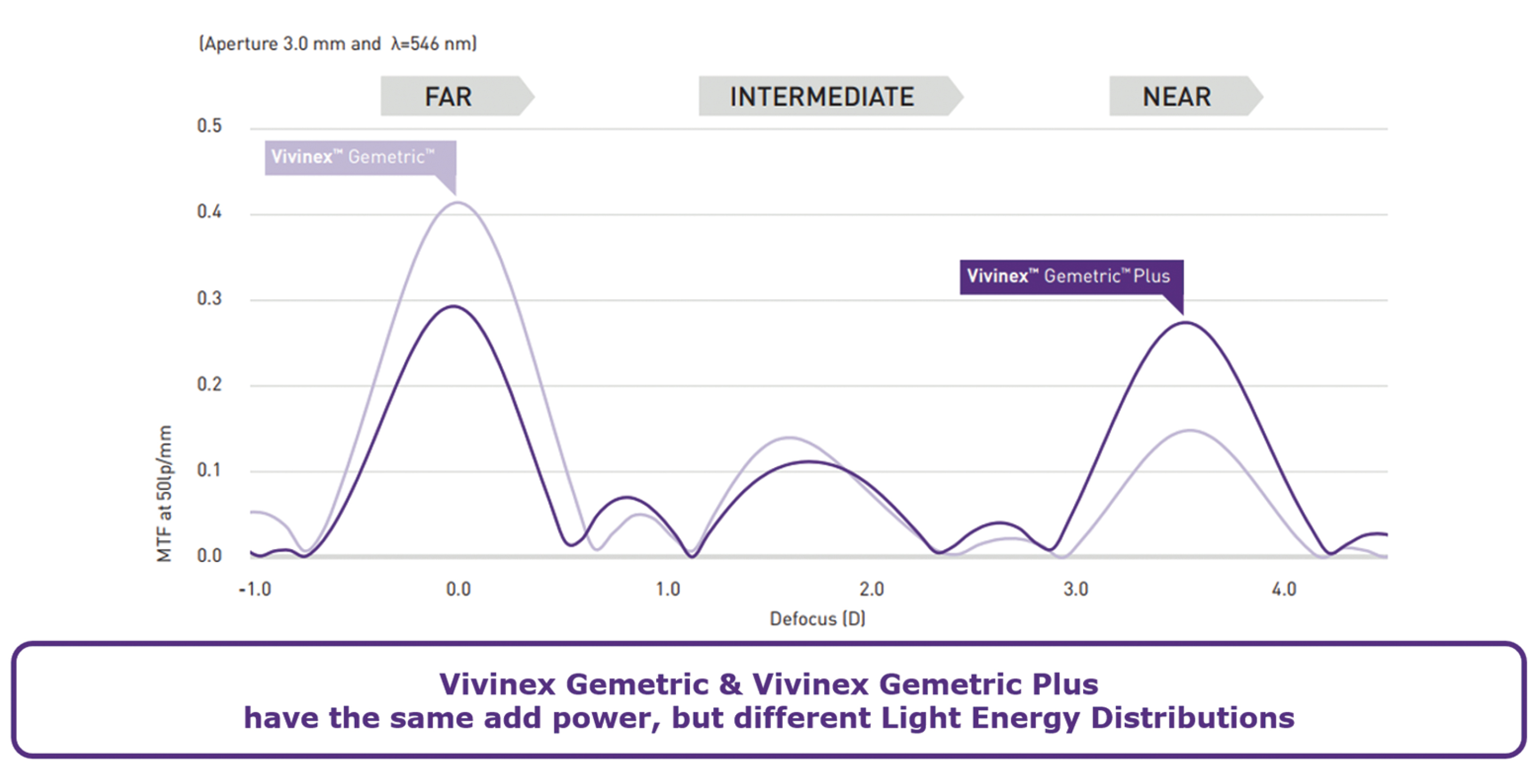
Figure 1. Simulated MTF through focus response of the two complementary profiles of Vivinex Gemetric (G) and Vivinex Gemetric Plus (GP) IOLs, which have the same add power, but different light energy distributions.
Across all of our available clinical data from multiple studies and 568 subjects,1 the Vivinex Gemetric lenses consistently achieved distance vision above 20/20. The data also showed a very low rate of glare, halos, and starbursts for both designs, as well as a very high level of spectacle independence for both the G and GP IOLs and very high overall patient satisfaction.
Real-world experience of approximately 350 eyes collected across more than 70 sites using CLEARlog shows a similar rate of glare but fewer halos and starbursts compared to patients enrolled in our clinical trials. Spectacle independence rates are also similar between the clinical trial and real-world experience.
1. HOYA Data on File. HOYA Medical Singapore, Pte. Ltd, 2023.

