
PresbyMAX Monocular
Our surgical treatment of choice for presbyopia correction.
With the aging population, presbyopia is now the most common refractive error worldwide. In many parts of the developed world, it is therefore not uncommon for individuals to spend half of their lives with presbyopia. A variety of surgical approaches to presbyopia correction, including PresbyMAX with the SCHWIND AMARIS excimer laser family, are available, each with its own risks and benefits. This article explores how PresbyMAX can help patients achieve spectacle independence and insights into its role for presbyopia correction.
BACKGROUND
Visual acuity at different vergences is a common indicator for the depth of focus of spatial vision that is applied in clinical settings, such as in the form of defocus curves.1 The impact of refractive error on visual acuity is well understood.2 Recently, the impact of higher-order aberrations (HOAs) on visual acuity,3 particularly extended depth of focus, has become increasingly important.4
Presbyopia correction on the cornea has been historically associated with a loss of distance vision and contrast sensitivity, which can reduce quality of vision (at least in the short- to mid-term).5 This is presumably due to the induction of corneal aberrations to increase the range of focus (ROF) in operated eyes.6 The negative effects of corneal refractive surgery are higher for more aggressive presbyopia treatments that aim to provide functional vision with an increased ROF.7 This has led to the development of newer blended vision approaches8 and treatments with different aims in the ROF for distance and near eyes.9
The losses of distance vision and contrast sensitivity seem to be more evident under monocular examining conditions and reduced under binocular vision conditions.10 This has led to the hypothesis that patients who have undergone monocular presbyopia treatment on the nondominant eye for distance may have better distance vision while retaining most of the gains in near vision compared to patients who have undergone bilateral presbyopia correction.11
PRESBYMAX PROFILE FOR PRESBYOPIA CORRECTION
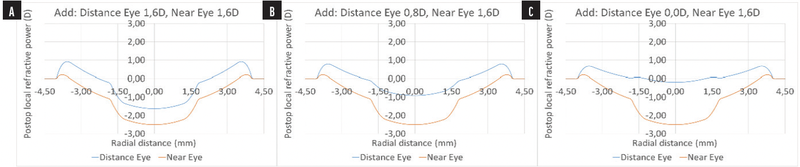
PresbyMAX uses an increased ROF profile for presbyopia correction12 that works by creating a prolate corneal shape, controlling the induction of negative spherical aberration, and inducing a low amount of myopia.13 The distance refractive correction is applied over the entire optical zone and progressively becomes hyperprolate toward the center. This shape is influenced by the amount of addition; the higher the addition, the more powerful the center becomes.14
The PresbyMAX concept incorporates a residual myopic defocus in the near eye15 that can be altered to induce more or less myopia combined with lower or higher adds (ie, less or more induction of negative spherical aberration).16 Different versions of the profile are depicted in Figures 1 and 2, assuming emmetropia for distance vision in the distance-only aspheric optimization takes place and there is a hyperpositive central aspheric region. For near eyes, a residual myopic defocus is targeted.


Both of us have experience performing PresbyMAX monocularly to maintain distance vision and visual quality while enhancing intermediate and near vision in the near eye through the concept of increased ROF. The monocular profile for PresbyMAX involves correcting one eye for distance vision using an aberration-free profile and correcting the contralateral eye with an increased ROF ablation. The ablation profile has been described elsewhere.17
When performed monocularly in the dominant eye, PresbyMAX is a more physiological approach than intraocular multifocality for the following reasons:
- It produces fewer negative effects for distance vision and visual quality;
- It allows patients to use any residual accommodative function in the natural lens to provide a more natural range of vision;
- It is possible to reverse the procedure;
- It is far less invasive than explanting or replacing an IOL; and
- If needed, spectacle correction can be used for night driving.
One of us (AB) determines the reading add preoperatively. Patients who require a reading add of +1.50 D or more receive a monocular PresbyMAX treatment whereas those who require lower amounts of add and who are happy to wear reading glasses for small print are treated with standard aberration-free monovision. For monocular PresbyMAX, a target refraction in the nondominant eye of -1.19 D is planned by adding +0.30 D to the refraction that is inputted into the laser (-0.89 D is the default in monocular PresbyMAX). An add value of +1.50 D is then selected and adjusted with an extra +0.05 D for every 1.00 D of myopia treated and +0.10 D is removed for every 1.00 D of hyperopia treated. An optical zone of 6.3 mm is selected for myopia and 6.5 mm for hyperopia and can be increased if needed in patients with large mesopic pupils to increase the ROF without losing too much quality of vision. Enhancement rates are low; this approach is a reliable tool for total spectacle independence in patients with presbyopia.
Monocular PresbyMAX allows comparisons of pre- and postoperative findings and distance (nonpresbyopic) and increased ROF (presbyopic) corrections. In other words, due to the target myopic refraction, the attempted spherical correction for the near eye is more hyperopic whereas the cylindrical correction and the optical and total ablation zones are similar. This is also reflected in the attempted ablation depth, which is approximately 13 µm shallower in the near eye for myopia and, conversely, deeper for hyperopia.
PATIENT SELECTION AND POSTOPERATIVE RESULTS
Patients with incipient to frank presbyopia, usually between the ages of 40 and 60+ years old, are good candidates for a monocular PresbyMAX procedure. The intended anisometropia is properly reached for the distance and near eyes; however, the spread of postoperative spherical equivalent is usually wider for the near eye. Astigmatism is equally corrected for both eyes. This demonstrates that the correction of astigmatism is largely independent from and not affected by the attempted increased ROF effect.18 The achieved BCVA should maximize visual acuity, and contrast at intermediate spatial frequencies should be maximized.
After monocular PresbyMAX, uncorrected distance visual acuity (UDVA) is an average of 3 lines better in the distance compared to the near eye. For the near eye, UDVA averages 20/40 to 20/32, with almost 50% of the near eyes reaching 20/32 or better. A binocular UDVA of 20/20 or better is achieved in almost all distance eyes, and a binocular uncorrected near visual acuity (UNVA) of J2 or better is achieved by virtually all eyes. This confirms the potential advantages of monocular presbyopic correction on the cornea.19
For a binocular defocus curve to increase the natural ROF of the visual system, at least four components are considered. The spherical refraction of either eye may be different to provide better vision at two distances, and the increased ROF of either eye to extend the range around the nominal vergence may be different between eyes to provide sharper vision in a narrow range of distances or more functional vision in a wider range depending on the targeted amount of myopia and the PresbyMAX addition value the surgeon chooses. The combination of both eyes contributes to the achieved visual acuity at all distances; both eyes actively participate in the visual process to create binocular vision impressions.20
BCVA is remarkably stable over the range of natural daylight pupil diameters after monocular PresbyMAX treatments. UCVA, however, depends heavily on pupil size in the case of blurred images. When a pinhole is placed in front of an ametropic eye, visual acuity can be increased drastically, even for considerable refractive errors, if the cause of ametropia lies in the optical pathway. This can be explained by the reduction of the blur circle area, which is proportional to the area of the pupil and drastically reduced by a small pinhole.21 However, the maximal visual acuity achieved with a pinhole is bounded by diffraction effects and falls short of the visual acuity rendered by the best correction with natural pupil diameters.22
With monocular PresbyMAX, corneal aberrations are not induced in the distance eye. There is, however, a slight induction of negative spherical aberration in the near eye with a mild postoperative difference of 0.20 D between eyes.
Correlations between the induced corneal spherical aberration (the treatment driver for increasing the ROF) with the refractive parameters show that about -0.10 D of corneal spherical aberration is induced per 1.00 D of planned addition. The correlation between the efficacy in the near eye and the refractive parameters shows that about 3 lines of UDVA (with respect to preoperative CDVA) are lost per 1.00 D of residual myopic refraction, combined with about 1 line of UDVA loss per 1.00 D of induced negative corneal spherical aberration.
CONCLUSION
Monocular presbyopia correction on the cornea with PresbyMAX can provide excellent monocular and binocular uncorrected distance visual acuity in the distance eye and very good binocular UNVA and monocular UNVA in the near eye. This represents an advantage for distance vision compared to patients receiving the presbyopic treatment binocularly.

The SCHWIND ATOS femtosecond laser and the SCHWIND AMARIS excimer laser product family provide a comprehensive treatment portfolio for refractive and therapeutic corneal surgery. Find out about their many advantages at www.eye-tech-solutions.com
Ready to Claim Your Credits?
You have attempts to pass this post-test. Take your time and review carefully before submitting.
Good luck!
Recommended
 Celebrating the Magic of Vision
Yesterday, Today, and Tomorrow: The Changing Face of Modern Refractive Surgery
John Marshall, PHDJohn Marshall, PHD- Celebrating the Magic of Vision
Wide Corneal Epithelial Mapping Using OCT
Jerry Tan, Mbbs(s'pore), FRCS(Edin), FRCOphth, FAMSJerry Tan, Mbbs(s'pore), FRCS(Edin), FRCOphth, FAMS - Celebrating the Magic of Vision
ATOS and SmartSight: Current Trends and Procedural Volume
Maja Bohac, MD; Victor Derhartunian, MDMaja Bohac, MD; Victor Derhartunian, MD